One thing I have learned is that for the most part, people express the same idea but they express it in many different ways and with many different words. It is the details in the expression, the words, and combination of words used, that give a story its colour, its texture, and brings it–and its lessons–to life.
We are unique combinations of our beliefs, values and life experiences. Differences notwithstanding, we, and our experiences, are important. Therefore, there is value in compiling and sharing these stories and the multitude of ways in which ideas are expressed. Combined, these stories weave a wonderful tapestry that exemplifies just how rich and beautiful life can be.
And who knows? An inadvertent remark or detail in the retelling of a story can stand to attention and have an impact in the world of a reader. And with that exciting possibility, perhaps the most valuable thing I can do is create the space where the stories of those whom I admire and respect can be shared.
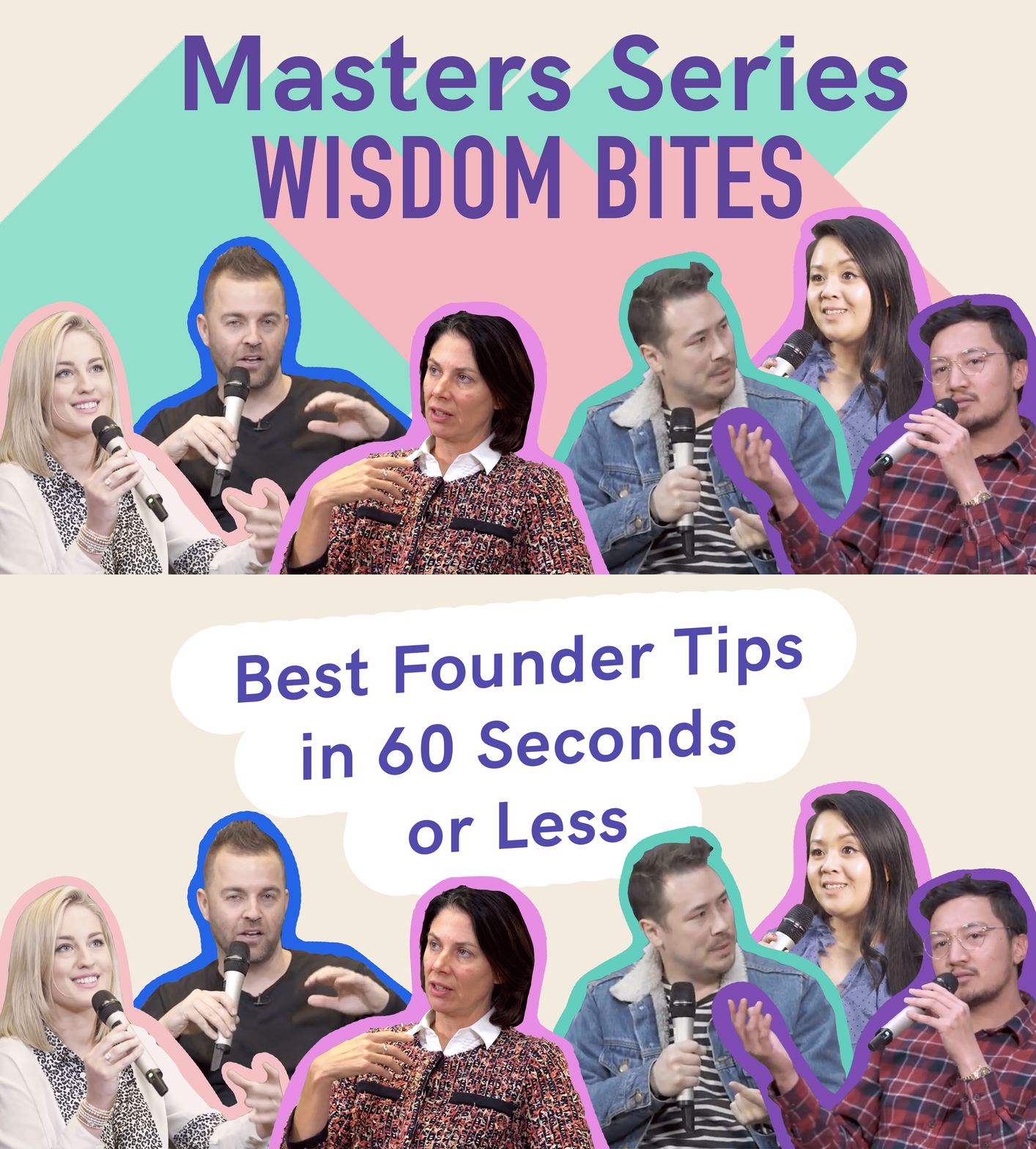
Below are people that I have come across on my own life journey whom I deeply admire and respect. Whether it be their tenacity or courage, or relentless drive or passion, each individual generously reveals a different lens in response to the questions I regularly pepper them with.
As we continue on our sharing over this anthology, I will share tidbits and anecdotes as to why I hold them in such high esteem, and what I love most about them. In turn, I hope that you do too.
What was the best business advice you have received?
Agonise over whether or not you need business partners
Ai-Ling Wong. Founder at The Decorateur, President at Entrepreneurs’ Organization. Kuala Lumpur, Malaysia.
Agonise over whether or not you need business partners. Alternatively, if you can afford it, don’t have business partners. 9 out of 10 entrepreneurs I know have long-term pain with theirs. The 10th entrepreneur without the headache is usually the one without a business partner. For me, not having a business partner is one less problem.
During my journey, people have asked me if I want to partner with them; usually because they know that I know how to work hard. I have held back because I place more value on the relationship.
Always look for the angles
Alex Louey. Founder and Managing Director at Appscore. Melbourne, Australia.
The best business advice I have received is “always look for the angles”. For example, if you’re pitching, selling, or proposing a partnership, you want to find out what will spark the other person’s interest so that they can’t help but want to work with you.
The act of “doing business” is a lot like dating; everyone likes something different. Your job is to find where the other person’s sweet spots are.
If their response is “no”, it’s not because they don’t want to use your product(s)/service(s). It’s because you just haven’t pitched your product(s)/service(s) to solve their problem(s).
Listen to your gut
Andrea Grisdale, Founder and CEO at IC Bellagio, Board Member at Entrepreneurs’ Organization. Bellagio, Lake Como.
Warren Rustand taught me the value of listening to my gut, and so I share with you the following: Always listen to your gut or your intuition.
Even if every single person in the room believes otherwise–and that room is filled with people who you believe are more experienced, more intelligent, and more prepared than you are–do what your instincts tell you you do. Listen to the point of view of others but go with your gut. It will never fail you.
Whenever I made a decision that was contrary to my gut or intuition, whether it be because I wanted to people please or I capitulated under the pressure of being surrounded by–in my opinion–people who were more intelligent, experienced or qualified than I was, those decisions have always turned out to be the wrong decision. Conversely, whenever I made a decision that honoured what with my gut or intuition was telling me, it was the right decision.
As I reflect on this, I cannot help but laugh. My dear friend Alonso (who has a tendency to analyse everything to the nth degree) becomes incredibly flustered by the “moments”.
Measure Twice. Cut Once.
Daniel Dickson, Managing Director at Amarco Enterprises. Sydney, Australia.
Ironically, what I now know is some of the best business advice I was given was in my year ten woodwork class by my then teacher, who was teaching woodwork to boys that were both frivolous and quick to make decisions on cutting into beautiful pieces of timber.
His message to me then–which has since stuck with me and I believe I still say it ten times a week to my current staff–is“measure twice cut once”. The reason this is so important is that often people are quick to make decisions or take actions, only to have to later use twice the time to fix any mistakes that could have been avoided.
“Measure twice cut once” ensures that that we do things properly, and prior to delivering, executing or starting, we ensure that all the checks and measures are taken to ensure our chances increase for a successful deployment or implementation.
Being the son of a builder, this adage is one of my favourites.
Do the most important thing at the start of the day
David Fastuca. Founder at Ambisie, Founder at Locomote. Melbourne, Australia.
Spend your first two hours of your work day doing the most important thing so that if you did nothing else, you would be happy. This is an idea that has been drummed into me over time by various mentors and business people. I find that I–and many people I know–have a tendency to get caught up in “doing things” that we forget, or worse, neglect the things that should be done to help move our businesses forward.
Never give someone else permission to treat you in a way that is contrary to your values, principles, and beliefs
Demi Markogiannaki. Founder at WeTeachMe. Melbourne, Australia.
The best advice I have ever received came from one of my mentors from the US. It’s an amazing life lesson, and one that I will carry with me for the rest of my life.
During one of our regular catchups, I was complaining about how I felt helpless while dealing with a co-worker that was being a bully. I remember vividly how I went on and on about how much I disliked the way my co-worker treated people, and the detrimental effect that this behaviour was having on the workplace culture.
I confessed how I constantly felt unhappy, stressed and unappreciated; how nothing was ever good enough; and how this co-worker had an uncanny ability to find the negative in just about everything.
After I finished unloading, my mentor looked at me in the eye and said, “I don’t feel sorry for you. I apologise if this sounds insensitive, but you are only allowing yourself and others to be bullied. Stand up for yourself. Build yourself up so that you will be able to handle situations like this. You have the power to call this co-worker out, and to tell them to shut up. If you, don’t have the ability to stand up for yourself, how are you going to stand up for, and support, others?”
My learning is that to be an effective leader, one that can both protect and elevate others, starts from being able to lead yourself. It starts from having the courage to stand up for your values, your principles, and your beliefs, and never ever give permission to anyone else to treat you in a way that is contrary to your values, principles and beliefs.
Find the puzzle pieces
Emma Welsh. Founder at Emma & Tom’s. Melbourne, Australia.
Talk to as many experienced people as you can. Each person that you talk to will have one small piece of the puzzle, and not the entire puzzle.
Your job, as an entrepreneur, is to find as many pieces of the puzzle as you can, from as many different, experienced people as possible, and then to construct your own version of that puzzle as best as you can.
Skills can be learned. Values cannot.
Jamie Skella. Chief Operating and Product Officer at Mogul, Former Chief Product Officer at Horizon State. Melbourne, Australia.
I didn’t have the luxury of mentors at my disposal as a young entrepreneur, so most of the business advice I garnered was done so at arms length as I closely watched those succeeding on the global stage (as well as those who were making mistakes).
One of the earliest meaningful pieces of advice I remember paying attention to was Richard Branson’s “most skills can be learned, but it is difficult to train people on their personality”.
Alas, some lessons need to be learnt first hand. In spite of Richard’s words, I still fell into the trap of hiring based on credentials instead of cultural compatibility at one critical juncture in the past. It’s not a mistake I’ve made since as a hiring manager and it’s also a learning I’ve carried over into my investments: I back entrepreneurs first and foremost and not their CVs; that distinction is critical.
Life is too short to learn everything through experience
Keith Roberts. Founder, Author and Speaker at OAKJournal, Board Member at Entrepreneurs’ Organization, President at Entrepreneur’s Organization, Founder and Creative Director at Zenman. Denver, Colorado.
This idea was taught to me by a gentleman by the name of James Webb. James and I couldn’t be more opposite in our personal life, but throughout the years we have become lifetime friends: The idea that “life is too short to learn everything through experience” applies to my business, my personal, and my family life. It seems like common sense, but when applied to all facets of your life, it can have a significant impact through: (1) avoiding pitfalls; and (2) identifying possibilities.
It means that you can avoid potential hardships by learning from what others have done or experienced before. The practice of looking into the past also reveals opportunities that may have previously gone unseen. Don’t make mistakes or miss the chance to capitalize on trends that are visible by looking at historical/competitor data.
Be unrelenting
Kym Huynh. Founder at WeTeachMe, President at Entrepreneurs’ Organization. Melbourne, Australia.
I grew up intimately watching, and bearing witness to, the ethos and work ethic of my Mother and my Father.
It is seared into every fibre of my being the unrelenting nature in their extreme work ethic, the strength in their inability to take no for an answer, the bravery in their conviction to stand up for what is right and fair, the audacity in their willingness to bulldoze through insurmountable odds, and the courage in their unrelenting ability to never, ever, give, up.
I cannot remember nor can I imagine a time when the above was not the case.
Let people go if you cannot serve them
Raymond Chou. Founder and CEO at Infront Consulting APAC. Kuala Lumpur, Malaysia.
I used to hate letting non-performers go because I had this strange thought in the back of my mind that said, “If you let them go, you will destroy their life.”
This little voice was challenged one day when I was asked, “If this person continues working for you, am I right to say he will never progress in his career?”
To this question I responded, “Yes”, to which they replied, “So why are you destroying this person’s career when you could let them go somewhere else where they can be a superstar?”
It was at this point that I finally understood the meaning of “letting someone go”. This is something that I have carried with me since.
The riches are in the niches
Ron Lovett. Founder and Chief Alignment Officer at Connolly Owens, Founder and Chief Community Officer at Vida Living, Author at Outrageous Empowerment. Halifax, Nova Scotia.
Verne Harnish shared an idea that I carry with me, and that idea is about focus: (1) take an industry and break it into sectors; (2) pick 10% of the overall sector where you think you have the most opportunity and can beat the competition; and (3) double down and completely focus there. Own 70% of that 10%!
In my last business (security guarding) we were focused on a model but not a market segment (customer). If I could go back and do things again, I would have put a lot more of my energies into focusing, and I believe that I would have built a much larger business as a result.
If you are in a crisis, committees of 1 make the best decisions
Tony Falkenstein. Founder and CEO at Just Life Group Limited, Founder and CEO at Just Water, President at Entrepreneurs’ Organization. Auckland, New Zealand.
In this time of COVID-19, I reflect on the advice from John Fernyhough, who was a very successful lawyer and entrepreneur in New Zealand. One of his great lines is “as a lawyer I will tell you what the legal position is, but then we decide what the commercial action is; that’s the fun part”!
John’s advice in a crisis is “take absolute control; you are like the pilot of a plane, you get paid the big money for when you are in trouble so forget discussions and meetings; just take the action you think is right, and execute fast”.
I became CEO of a long established family company that had gone public; it had millions of dollars of obsolete stock, it had no good processes, controls or reporting, it rented a building that it didn’t need, and every Executive had an Executive Assistant. The son of the Founder was the Production Manager, the Board had monthly catered meetings with drinks and yet the Company was insolvent. The Directors hadn’t realised it. Nobody had.
I drew big red crosses through the management team, including the Founder’s son, rented out the excess building, found a creative way we could use the stock, put a customer service person who had a “just do it” attitude into credit control, and found a new major revenue product. I went to the bank who had the company ‘under watch’, told them what had been done, and said they could put us in receivership now, or lend us more money.
All this happened within one month from joining. We then developed the new management team from existing staff who stepped up to the plate.
The result? The company’s share price moved from 48 cents to over $13 in 3 years. The big learning: First impressions are generally right, so if you are in a crisis, committees of 1 make the best decisions.
What do you think?
Do you agree or violently disagree with anything shared in this article? Or do you have any of your own stories that you want to share? Pop them in the comments and I will personally reply.
Call to action
My goal is to help 1,000,000 people. My wish is to have these articles shared 1,000,000 times through the various social networks. For this reason, I provide this collection online for free and all I ask of you is this: If any of these articles have helped you in any way, please take a moment to share on social media, email to someone you think will find benefit, or print and leave it on the desk of someone whom you believe has the motivation, but lacks the tools to take themselves to the next level.
Don’t miss out on any new articles. Subscribe via email using the form at the bottom of this post and I’ll have the articles delivered straight to your inbox. Alternatively, you can also follow me on my various social media accounts: Facebook, Instagram, LinkedIn, and Twitter.
Artificial intelligence (AI) has been changing our lives for decades but never has it felt more ubiquitous than now. From Siri to self-driving cars, AI is progressing rapidly and is becoming embedded in our everyday lives.
Susie Sheldrick works with technology consultants Silverpond, who are empowering 7-Eleven, Powercor, and Australia Post with AI. Susie reveals that we don’t know how AI makes decisions and that’s what makes it such an exciting field to be working in.
Mark Chatterton is co-founder of inGenious AI, who are using Natural Language Programming (NLP) to create chatbots with a human feel. Mark’s goal is to eliminate interfaces with AI so that we can talk to them in the same way we talk with friends and family.
Disclaimer: Transcripts may contain a few typos. Similar sounding words can lead to them being deciphered wrongly and hence transcribed likewise.
Interviewing Public: I think from my perspective I’m looking at it and how to use AI in data science and data analytics so that I can customize and personalize customer experience better hopefully get insights groups customer into segment of one.
Interviewing Public: Well the particular business that I’m employed by uses it for vision systems, drone vision systems for the defense industry so basically are in involves object detection object tracking in video from a drone.
Serpil Senelmis: For WeTeachMe, this is the Masters Series where industry professionals share their secrets to success. I’m Serpil Senelmis from Written and Recorded. Watch out the robots are coming or are they here already? And should we be worried? If you stop to think about Artificial Intelligence for a moment, the reality isn’t anything like we see in the movies. The fact is, AI has seeped into almost every aspect of our everyday lives. And in a major way. Can anybody say, Alexa or Siri? So it’s not surprising then that machine learning and task automation are widely used in business these days. But how will AI continue to shape the future of business? And what do businesses need to do to keep up with AI in order to gain the most out of their marketing efforts? Mark Chatterton is co-founder of inGenious AI, which designs and builds chatbots using conversational interfaces and artificial intelligence. Mark says high accessibility is making conversational chatbots a game-changer.
Mark Chatterton: Just like today we’ve gotten up and started talking the closest thing to an interface is I need to speak English. That’s it. So there hasn’t been an interface you’d need to learn you don’t need to start to understand the buttons on my face or anything like that. It just starts talking.
Serpil Senelmis: We’ll hear from Mark soon, but first, Susie Sheldrick. She’s the marketing and community manager at Silverpond, a technology consulting company. Silverpond has been working with startups and organizations such as 711 and Australia Post to help them navigate major technological trends, including AI. Susie outlines the different types of AI that are available, and the scary thing, apparently, we don’t know why AI thinks the way it does.
Susie Sheldrick: Yeah, I’m from Silverpond, where a machine learning company where a team of data scientists, technologists, marketers, and software engineers, and our aim is to accelerate the adoption of AI. So just because we have that range, we’re just going to set a bit of the scene of what what is AI and machine learning and deep learning. So we’ve got artificial intelligence which is like computers mimicking human intelligence. From there we’ve got machine learning which as it sounds is where we teach machines how to learn, instead of programming the rules and it finding out the answers, we’re giving the machine’s problems that we don’t quite know how to create the rules for. So the popular internet option is cats, for example, setting the rules of how to give a computer a new image of a cat and define that is actually really hard, giving the computer an image of a cat and giving them thousands and thousands of that it will learn its own way of defining that is a cat. So that’s sort of the benefits of machine learning. And deep learning, which is taking its inspiration from the way the human brain works, and that’s why you’ll see a lot of brains been associated with deep learning and AI because it’s using those neural networks. So we’re going to talk about a few of the applications that we at Silverpond have been using deep learning predominantly, but especially a lot of machine learning. Sports analytics, traditionally, things like Hawkeye have been huge in Grand Slams and professional tennis. But that requires eight cameras in a very complex computer network. What we’ve been doing is working out how to use object detection. And instead of having these eight cameras, it can be reduced to the cameras are already being used by the television networks and a computer model. Road analytics, traditionally used are these rubber tubes. But the rubber tubes can’t tell you what type of cars are going over. And that’s really important for the road authorities to know like Alamo commercial vehicles being used, the sizes and that kind of thing. Asset detection to do these sorts of visual inspections requires a person either going up in a helicopter or on a crane with lots of costs and our h&s considerations, we’ve been able to use machines to detect not only the number of assets but also are they in good neck. Time series data for this is about the measure of smart meters over the course of time. And time series data is used a lot for prediction like stock market predictions, if you ever see machine learning and the stock exchange, they’re using time series data. And this is a bit of a scary thought for people the first time they hear it, but we don’t fully know why AI thinks the way it does. And makes the decisions that it does by giving it the opportunity to learn its own rules. We’re still trying to find out what those rules are. And so trying to understand how AI comes up with the decisions it does, is really important, and that’s called explainability, which goes into like, the transparency where machine learning gets really cool and interesting is when it’s doing things better than people. So previously, this case had a detection rate of about 40% based on people analyzing the images that went up to 70 to 80%. within the first few weeks using the Silverpond model. Ai isn’t perfect, it can still be tricked and this is an important case for when it was going with autonomous vehicles, where the model was able to be tricked with just stickers being placed over the stop sign. So these are things that we need to overcome before we have the autonomous vehicles running on the road. Back to interpretability. So we’ve got a lot of really great ideas, but understanding why AI makes the decisions that it does is something that does need a lot of research when it’s taking cats from the internet. Not so important when it’s being used in justice systems like it is in a number of countries and especially the states, they’re using AI models to sentence people and you know, decide on their parole, their bail, things like that. And so understanding how it is that the AI came up with that decision is incredibly important in situations like that. Bias, so it is from a story where this lovely young gentleman didn’t fit the passport criteria because the AI model said that his eyes were close which clearly they’re not the problem there was there wasn’t a wide enough data set used to train the model. Yeah, you really need to have a really good data set and a diverse data set, depending on your needs, of course. But if you’re detecting people, you need to have all different types of people in your data set. If it’s bad data going in, you’re gonna have bad models coming out. If it’s not diverse going in, it’s not going to be very effective coming out.
South Korea has got the greatest density of robots in the world. They’re really at the cutting edge with robotics. And so holding such a world event, such as the Winter Olympics, they wanted to really make the most of that. So they had about 85 different robots on the grounds doing a number of things. There was the robotic fish in the fish tank. I’m not sure what the purpose was, but they were there. Then you had greeters at the airport that could answer basic questions and direct people towards another human that could get them in the right way. They had them doing planning. So essentially that the robo-backs on steroids as well as drink dispenses, and things like that. And then we also had the robot skiing championships, which wasn’t an olympic event. But there were plenty of winners, and quite funnily cash prizes for the robots, but not for the people competing in the game. But what was really interesting about this, so we’ve got Korea, which is probably the most advanced country with robotics, and certainly right at the cutting edge, and this great big world event. And yet each of these robots had a person by them the whole time, they weren’t confident enough to have the robots roam free, or they weren’t confident enough with the people. So I think that says a lot with where we actually are with maturity and AI and robotics is that they’re doing some really great things, but it’s not quite at the stage of letting them sort of run free and take over as many people are worried about. Another thing to be mindful of with AI is the ethics and regulation and thankfully we’re seeing a lot more interest happening in this. The days of the engineer going, I just build the thing someone else can deal with it as heartfully becoming behind us where people are actually being mindful of what they’re creating now, and where that’s going to be in a few years time. To that as well governments are really getting on board with making sure they’re not making the laws 20 years too late, which is traditionally happened with technology the big government has done in Australia first with creating the all-party parliamentary AI Committee, which is fantastic that they’re getting this together and making sure the right regulations are in place, as well as the right support for the industry in Victoria. And then we’ve got things like the AI Now Institute, which is a leading ethics body. And then universities such as Harvard, MIT, and Stanford are really leading the way with offering ethics courses within their computer science degrees so that the people that are going to be graduating within years to come, are going to have that background of thinking what are the implications of what I’m creating. So if you’re wanting to get started really start small and experiment. Play around with some great tools online and data sets you can play with tools you can start to play with. So start small experiment and work out what’s right for you. And that’s all we’ve got for today. Thank you.
Serpil Senelmis: So well AI is often better than humans at detecting detail, it’s still not perfect and can be tricked. In a moment we’ll meet Mark Chatterton, watching large corporations cut corners in customer service drove Mark to want to deliver a better customer service experience. He found the solution in chatbots. You’ll hear more on that right after this.
Ad Guy: If you’ve ever wanted to upskill learn something new or just follow your passion, WeTeachMe can help you get there. WeTeachMe is like the eBay of lessons. We can help you become a barista, a baker, or a blockchain expert. You will find all the best workshops, classes, and courses happening around the country at the click of a button. Find classes near you at weteachme.com. And every week WeTeachMe’s Masters Series podcast connects you with industry professionals to help your startup to take off. The Masters Series podcast is brought to you by Written and Recorded. Journalists for hire, Written and Recorded create memorable content that helps your business rise above the noise. From blogs to podcasts, social media to feature articles, Written and Recorded will shape your content to bolster your brand. Find out how content can amplify your message at writtenandrecorded.com. And now, back to the robots.
Serpil Senelmis: Mark Chatterton is co-founder of inGenious AI. It’s a company that creates conversational interfaces, which enable customers to communicate with companies in the same way they would with friends. Mark says by 2021, more than 50% of enterprises will spend more per annum on bots and chatbot creation than traditional mobile app development.
Mark Chatterton: So what we found is every 10 years has been a generational shift in interfaces. So what we mean by that is, basically, in the late 90s, the websites with the cool thing to do so we’re all building websites. So that’s been going for quite a while now. In 2008, Apple released their ecosystem for building apps on the iPhone or whatnot. And then the app started to explode and people were getting lots and lots of apps on there. And finally, in 2018, we’re seeing conversational being the new interface, and what we mean by conversational is just like today we’ve gotten up, we’ve started talking, the closest thing to an interface is I need to speak English. That’s it. So there hasn’t been an interface you’d need to learn, you don’t need to start to understand the buttons on my face anything like that, it’s just start talking. And we can actually start to have a two-way conversation like that. So it’s that very high accessibility, that enables conversational to be a bit of a game-changer. So what is a chatbot? The chatbot is basically a robot that understands that wage and can process it and start to do actions off it. So you know, screaming at your Alexa to turn the lights off and things like that it can actually do it in action. So the first thing is to understand the difference between conversation and search is one of the big challenges. Search is all about asking a question into something like Google. But the problem then is you kind of have to know the right question to ask. And then you have to do all the work. So Google, you’ll fire off a question like, Hey, I’m looking to purchase an SUV. And Google sort of taunt you and say, here’s 9 million results in point five, seven seconds. Like, that’s great. Now we got to read through all of them to try to figure out what car is right for me, it’s great that Google can sort of give you all that information very quickly. And it tries its best to try and put the most relevant stuff to the top. But still, it’s pushing all the work back onto you. But think about how a conversation goes. So if you call up someone or go into a dealer, and you’re not sure about what type of car you want, there’s a conversation. There’s an interaction that goes, well, what are you looking forward to? Do you have a family? Do you want to tow a boat? Looking for a sports car? You trying to compensate for being bored? That type of stuff. So it’s all these bits of information that come in through that interaction, and you end up narrowing things down. So it’s this ping pong of conversation that goes through. And one of the important things is that as a human, we’re kind of pretty crap, basically, the computer can do a lot more than us in the fact that we can maybe remember in the one sort of conversation three to five things at a time, but going beyond that, it starts to really stress our cognitive load, as they call it. So keeping that cognitive load low enables us to do a lot more, a lot more efficiently. So asking one question at a time and bouncing back is nice and simple, asking me to think about all the different parameters in like, one blurb straight out is quite challenging. And also, it’s from a momentum point of view with conversation. It’s not so much the number of terms, but the amount of thinking that required to progress. So as a quick example, when you go into like a barista or something like that, they’ll ask you, hey, hey, going, what would you like? Not what do you want, right? It’s not about shortening the experience to the minimum thing, like, you know, if they really want to be rude to be what? So, but if that’s a hell how she interacted with you, there’s no way you go back in like you rude burger. Right? I’m not doing that. So understanding that conversation is a lot more nuance to it, and it’s a lot more about the experience.
Mark Chatterton: So what’s the technology that drives a lot of the chatbots? Well as the silver home to humans sort of mentioned the natural language processing or NLP is a big part of it. That’s all about understanding not just the words, but your intent. So for example, take the word hot, so hot can mean spicy can mean temperature can mean sexy can mean stolen. So there’s all these different meanings for the same pronunciation and the same spelling, how the hell is a computer gonna understand what we’re saying? So if you boil that down, it comes down to context. So if I’m talking about a pizza, probably not talking about a sexy pizza or a stolen pizza, it’s going to be a spicy pizza. So it’s understanding that context. Now while the NLP is getting good, it’s nowhere near foolproof today. But they’re improving it. The other main technology is speech recognition. So just speech to text recognition, so being able to translate what we say so that the computer can have a chance at understanding that feeding into NLP. So the way it works is the speech recognition, understands our words, converted into text, fix it through an NLP to understand the intent of what we’re doing, and then starts to do an action. So for example, what’s the weather Nolan, translate the text sends it off to NLP, yep, Melbourne, Australia, send it back. And then finally natural speech generation. And that’s all about making sure that we can understand the computer back to us so they can generate the speech in a natural way. So you’ve probably heard of Siri and things like that talking to you, they’re slowly getting better on the way that that voice is coming back to you so that it does sound as natural as possible and not as disjointed as the old school robotic sort of wording that used to do so the whole sentence links together, it’s not just saying the words after, after each other. So one of the types of chatbots. So just from a very high-level technical view, there’s kind of rule-based ones these are fairly simplistic in the fact that it’s a big If This, Then, That. So if I’m looking at home loans, then this is the content that you want to look at. So it’s fairly simple to build from a flow point of view, but it doesn’t suit all scenarios, things like that. The other way is what I call AI-based or NLP based and this is typically Siri engagements or Alexa at the moment is short, sharp engagements where it’s question answer, question, answer question, answer. There’s not too much of a flow to it. So what’s the weather in Melbourne? It’s raining as usual, not a lot of depth to it. And finally, the best model that we’ve sort of found at the moon is actually a hybrid approach. So, as an example, if you’re a bank, I can start the conversation of, hey, what are the fees? The bots going to go? Well, like a human would? Well, this, we’ve got lots of stuff with fees or products that you’re interested in. So then they can go home loans. All right, cool. So let’s talk about home loan fees. But if I was already talking to you about home loans, and I asked what are the fees? Don’t come back to me and say, what products do you want? Like I’m obviously been talking to you about home loan. So tell me the fees about home loan. So understand that context. And the context is one of the big challenges with chatbots and making sure that it’s managed correctly and set correctly. So go some quick examples. This is a very simple messaging chatbot to gift bot called giddy, and they’ve got a really good engine at the back end that’s done. I guess. quirky gift recommendations. So as just some very quick questions about your friend that you’re trying to buy the gift for, and then it’ll start to provide a recommendation. So it’s just basically a bit of a q&a that it does and then provide some smart recommendation. And I found this with the combination between the channel being the Facebook Messenger, and the really smart AI engineer the back end doing the recommendations. We’ve got about a 30 to 40% conversion rate on doing things like that. So the combination can be quite powerful. Why Facebook Messenger, especially for Australia, the main one is that there’s 12 point 4 million monthly active users on messenger. And to give you an idea of Australia’s population, if you remove under 13 and over 75 because they’re still running letters that is about 70 to 75% of Australia’s population that monthly active users on that channel, so it’s a huge chunk. It’s also a persistent channel. Just like with your friends and family. If you start chatting, it’s a channel that you can jump back into at any point and continue the conversation. You’ve got a history and things like that. So the same thing can be with the chatbots. And to give an example, say for example, you’ve been talking with Australia Post, you’ve identified yourself and things like that being able to jump back in and go, where’s my parcel, as opposed to busting out the tracking ID and all the other bits and pieces just with my parcel? Because that’s directly getting to the answer you’re looking for. That’s pretty feature-rich. So you can do location sharing, you can share images, short video clips, it’s interactive. And you can do things like account linking and stuff like that as well. So you can match it with your Australia Post account. Obviously, importantly, no app downloading, which is a big thing at the moment, like getting people to download apps is pretty tough. Like, just think about how many apps you’ve downloaded recently, I think there’s a statin that’s coming out of the US that the majority of people haven’t downloaded an app in over 12 months. So it’s pretty tough now to get people to download new apps. So chatbots are a very quick and easy way because it’s already in an ecosystem that people are playing with. And messaging apps are becoming the number one place where people are spending their time the moment as well. So it’s taken over from Instagram and Facebook and other social media platforms. Now account set up. So there’s a fair bit of information that’s out there that’s provided as part of that initial conversation, like their name and things like that. And finally, notifications are enabled. So because their friends and family are already talking to them on this on this channel, most people have enabled notifications on by default so they can get their messages from their friends and family. So as a business, you can reach out to them and say hello as well. But obviously be conscious of the fact that if you abuse it, you will be using a very sensitive channel for two people. So example of voice so Alexa’s just come out in February in Australia, but it’s been out in the US for going on three or four years now. So it’s got a quite a head start. So obviously, you can just ask it to pay your credit card bill and things like that. So once you’ve done the account linking side of it, which is a little process you go through, you can then start to ask it to do very simple tasks like what’s my balance, please pay my credit card bills, things like that. And it goes through a very simple flow from that point of view to say, alright, well which account do I want me to transfer the money from to pay card, that type of stuff.
Mark Chatterton: So as an example, large bank that was part of the launch, for Alexa, they’re only getting about 200 users a month thru they bought at the moment. So voice within Australia is still a very niche thing but it will start to grow very rapidly once the devices get out there. And so Alexa is kind of cool. So you can play with the voice of Alexa a little bit. So you can whisper you can pause and add basic emotions in there. So you can play with the actual way that Alexa talks back to you and things like that. And notifications are enabled. So on the voice platforms, you can actually do push notification, so they just have the for Alexa, the ring goes yellow. So when you walk in after work or something like that, the yellow ring, you can kind of go like so what are my notifications and it will start telling you. So when should you consider a chatbot? There’s a lot of use cases that people think would be great, but these are some of the basic rules that we use for clients, big payoff little effort. So asking for an Uber to the airport and saying you know, Alexa, book me over to the airport is a lot quicker than opening your phone, unlocking your phone and going into Uber typing in airport, that type of stuff. So it’s probably like a minute to go through the app versus three-second soundbite, from that point of view. It’s more convenient, so this whole process here is what they call the raw chicken moment. So you’re in the kitchen, you cook, and you’ve got raw chicken all over your hands, and you have to do something. So you can just using your voice, tell it to do something. So you don’t need to put the chicken down to deal with whatever problem you’re trying to solve at that point in time. On top of mine answers, so this is one thing to remember. So the difference between voice and text does have a big impact depending on the use case. So for example, if I’m on a voice bot, and I asked you, hey, what’s your textphone number, there’s very rarely many people in the room would actually know that off the top of their head, but you could recite to me your mobile number or your address, things like that. So understand the different mediums so on voice, it’s very time-sensitive, whereas on text-based things you’ve got a bit more time I can sort of put that down, go get the details and punch it in. Gardeners trying this stuff out, they were just always liked, because it’s what we’re doing. But the gist of it is, but in 2021 more than 50% of enterprises will spend more per annum on bots and chatbot creation than traditional mobile app development. And the reason for that is actually becoming quite expensive to actually build out and maintain like, Apple keeps throwing out a new damn interface and updates and whatnot, you need to get on top of it, make sure it’s fresh, the UX designers sort of changed the way things are working. So you have to keep current with the new trends. Whereas the chatbot it’s just the content, there’s no interface, so I can build an Alexa skill. And all I need to do is make sure that you can talk to it. So that interface isn’t really going to change for quite a while. So from the development point of view, it’s nice and simplistic. It’s a lot cheaper to build and enhance these quickly.
Mark Chatterton: So the chatbot content, can we just get the AI to create the content gonna destroy my frequently asked questions, website at the AI and go dip, just learn it and then start telling our customers what to do. Well to the earlier point around the Harry Potter one, some of the weird and wonderful stuff that really come out of it. So the tall death era was wearing a shirt that said Hermoine has forgotten how to dance, so Hermoine dipped his face in mud. Right. And the scary part about this one is there was some humans just giving, when AI got stuck, it sort of showed them like two or three options, and the human had to pick the best one. So even though there was like still some corrections from humans in this, it’s still basically come up with this weird and wonderful story that made no very little sense. What we’re doing at the moment is manually creating that and the reason for that is a number of things is one that I really do suck at it, but also the experience you’re trying to craft. So if you think about the way that call centers are trying to die, like they get given scripts, and I get told that I had a great people and a lot of the stuff is very, very artificial. And you know why they’re kind of turning humans into robots. So we kind of go well, let’s turn the robots in the robots, but take that same thinking about the conversation content and the way you you’re constructing it and teach the robots how to do that. So we do that very simply by creating a persona. So what’s the conversational tone? Do you use emojis? Do you drop a GIF in there every now and then to spice things up? So how do you want to do it? Having a doctor be really funny and cheeky towards you probably isn’t going to be important in trust with you so being understanding of the right time for the right purpose and things like that, it’s very, very important. And we actually see that there’s going to be a kind of a new role, kind of a conversational design going forward. And the cool part about that is the roles are coming from weird and wonderful places. So while you know everyone’s looking at stem, and we need more people to sort of jump into that ecosystem, we actually see there’s going to be a role now for the more of the arts and the fluffy side of the education side of things. So some of our best conversational designers. A lawyer, he wrote some great stuff and your lawyer’s conversational design, but they used to writing very structured documents and explaining it to people is something that’s very common in an easy way. And another one was actually HR. So you know, human resources, they’re always trying to take these legal documents and get people to follow the process and the procedures within these organizations, giving managers tips on how to performance, manage people and things like that. So it’s weird and wonderful where their skill sets are coming from for that side of things. The other thing we’re finding is there’s sort of golden errors, as we say. So we had an insurance client, and he sells business insurance for some 1200 occupations. So he had a bunch of people coming in, and I started to ask do you sell Uber driver insurance? He didn’t sell it at that point in time, but he was getting like, a bunch of people a month asking that one question. He’s like, Well, obviously, this is a product that people want. So I’ll just tweak my existing cab, sort of policy to be Uber driver one, and then I’ll sell that. So if he wasn’t looking at those the errors in the insights, then he wouldn’t be getting that. So what we sort of say is, don’t give the errors to the devs to fix so they go yeah, sorry, we don’t sell that product. Okay. Give it to the marketing and the product teams to get the insights that have What their customers are saying to them because chatbots are very cool in the fact that they’re instantly available. They never going to judge the person for stupid questions. But it’s also important to remember that texts and screens aren’t going anywhere. But pitcher will always say 1000 words, NAB found that the perfect number of transactions is 20 displayed on a screen. But no one listened to 20 transactions over voice, it was just too many, no one got past three. So understanding the differences between the two is very important. Plus voice is not very private, if you’re in a public space, like I’m not going to go reschedule my colonoscopy appointment over voice on the trank, but I’ll type it in. So there still will be use cases for that. So for us, we see conversation is being our first and last UI. You know, 100,000 years ago, we began this journey as a species to speak to each other and have conversations. And now we’ve finally got the technology to be able to do it to the point where it understands us again, with that. Thank you very much.
Serpil Senelmis: I just love how chatbots have a low level of judgment compared to us humans. Thanks, Mark. And thanks, Susie. I’m so glad that the robots are our friends. Next week when you will startup isn’t a startup anymore. You’ll learn to take off your training wheels, scale-up, and propel your business to the next phase. Until then, I’m Serpil Senelmis from Written and Recorded and for WeTeachMe, this is the Masters Series.
About Masters Series by WeTeachMe
Masters Series is a show about inspiring entrepreneurs, creative thinkers, and visionary dreamers, and the stories behind how they built their companies.
“After I launched my business online, I started selling cupcakes at the markets. I set my market-selling date before I registered my home kitchen because I knew that if I set a date, and put down a deposit to sell at a farmers’ market, I would be pushed to tick off all the tasks on my list: (1) create the product line; (2) create the flavours; (3) create a menu; (4) register a business name; and (5) get the food registration, etc. I wanted to work backward with a timeline. If you have a goal and you don’t have set a date, you tend to let things drag it on. That’s how I made myself accountable for making my business work.” – Sheryl Thai
“I started thinking about how other entrepreneurs work because I didn’t feel like an entrepreneur. I didn’t think I was an entrepreneur. I knew that I had a “small business owner” mindset because I wanted to do everything and didn’t want to delegate. That realisation was a defining moment. There was a time when I was so tired, I was taking cupcakes out of the oven, and my arms couldn’t live the trays because of how heavy they were. I remember dropping them and I broke down and ran off to the cupboard upstairs. I locked myself in there and cried for an hour. I needed to change and figure out how to be an entrepreneur. That’s when I started finding other people that was doing what I wanted to do and started learning from them.” – Sheryl Thai
“I picked up the phone, called up a law firm, and said, “Hi! I can build websites for you.” The lawyer said, “No. You can’t. Good luck.” He hung up on me. I was crushed. After that, I felt like I was a terrible salesperson for a very long time. When I consider sales with WeTeachMe, I find that WeTeachMe touches on who I am and my core values, so I don’t really need to “sell it”. I talk about the “why”. Why am I passionate about WeTeachMe? Why am I passionate about learning? Why am I passionate about education? And why did I start WeTeachMe? I found that our first 100 customers bought into me.” – Kym Huynh
“One of the most exciting things about starting your own business is that you get to create the world as you see it. You get to instill it with the values that are important to you. And you get to fill it with people who align with your values.” – Kym Huynh
“Our decisions on who we hire, celebrate, or fire is based on values. When your values are clear and simple, they provide a framework for people to make decisions; what to do, and what not to do.” – Kym Huynh
“Our lives are so short. Things can happen through no fault of our own. We might be at the wrong place at the wrong time. I do not want to spend an iota of time doing something unless I am incredibly passionate about it.” – Kym Huynh
“I believe in this idea that learning is something that you carry with you for the rest of your life, and it’s one of those things that no one can ever take away from you without your consent. In life you can lose your job, your house, the clothes on your back, but you will never lose the knowledge in your head, and with that knowledge you can always start again.” – Kym Huynh
“The one you want to listen to is the one that has achieved you want want to achieve. I say to this person, “Teach me everything you know. I’m going to sit, I’m going to absorb, and I’m going to be willing student.” – Kym Huynh
“With goal setting, the most amazing thing is when I have clarity in my 10 years goals, and break that down into years 5, 3 and 1. I started achieving my 3 year goal in 1, 5 year goals in 3, and 10 year goals in 5. Every year I reset the 10-5-3-1. It’s this incredible accelerated pace of achieving goals.” – Kym Huynh
“Sometimes you can be your own mentor by reading. I love reading. I listen to podcasts nearly every day. It’s about continual growth. I ask a lot of people what they listen to and what they read. I believe that success leaves clues and so you find people that have done it or created something that you want to create, and you can learn from them. It’s a shortcut.” – Sheryl Thai
“Before I was made redundant, I had already starting little things on the side and baking cupcakes for friends and family. When starting a business, sacrificing your Friday nights is just one of those things that you have to live with. I was at home and waking up and thinking about my business way past midnight. Weekends were dedicated to improving my baking skills and to learning as much as possible. I did for that a good year before I was made redundant at my job.” – Sheryl Thai
“There really is no concept of “full time”. It’s all encompassing. It’s all I think about, all the time; from the moment I wake up to the moment I fall asleep. It’s not segmented 9-5 5 days per week. It’s just… life. Life melts into this big cacophony of everything.” – Kym Huynh
“The days are long and the years are short.” – Kym Huynh
“What’s really helped me is realising that a lot of entrepreneurs go through the same thing.” – Sheryl Thai
“The bigger my businesses is, the more money I make, and the bigger my challenges are. For me, I now see my challenges as a privilege to deal with them because it means that I’m growing. The challenge is a learning for me.” – Sheryl Thai
With thanks to
Sheryl Thai founded Cupcake Central (and League of Extraordinary Women) because guess what – she loves cupcakes! Her passion has risen out of her kitchen to 5 store locations across Melbourne with millions of cupcakes served and just as many diets broken! Sheryl describes how she discovered her passion and what she did to be able to enjoy the sweet taste of success.
Kym Huynh is a Founder at WeTeachMe and the driving force behind Masters Series. Kym discovered his passion for teaching after a bad car accident prompted him to think about what was important to him in this life. He’s now planning to turn his passion into the world’s biggest school without campuses.
About Masters Series by WeTeachMe
Masters Series is a show about inspiring entrepreneurs, creative thinkers, and visionary dreamers, and the stories behind how they built their companies.
“I’ve had a number of competitors approach me to buy me out and I just think, “I prefer to compete with you. I believe in where I’m going and what I’m doing, and I believe in our capabilities and our capacity.” If I was 65, 70 or 80… maybe… but running my own show and owning the decisions I make gets me out of bed. It’s on me.” – Jamie Lingham
“I’m thankful for every single aspect of all the things that happened because it taught me so much. For example, you trust the people you have, and I’m not saying you can’t trust people, but put systems and processes in place so you can check things. Have robust systems with redundancies in place so that if something goes wrong you’re alerted quickly.” – Jamie Lingham
“I ended up spending a week in hospital burned out at the age of 31. I’ve never ever worked those sort of hours again. I choose not to. The business is a vehicle to fund the lifestyle that I want to create for me and my kids.” – Graham Van Damme
“Find a mentor. Find someone who has grey hair. Who has done it before. Learn from their experiences. The learning curve is vertical. There are people out there prepared to share their time. Take them for lunch. Take them for coffee. Leverage off their lessons.” – Graham Van Damme
“Put 10% away. Pay yourself first. Fight to protect that facility. Put 10% away no matter what.” – Jamie Lingham
With thanks to
Jamie Langham is the CEO of Absolute Immigration who help businesses and individuals migrate successfully. Jamie’s business in Melbourne was going well in 2008, so he decided to put on a General Manager, and expand into Brisbane with an office and three staff. The GFC peaked a week later, but that wasn’t the only challenge the universe had in store for him.
Graham Van Damme is the Managing Director of Jag Capital. As a mining engineer, he bought into the business he was working for and began growing profits immediately. In 2008 he sold the business to private equity with the promise of even more ongoing profits. When the GFC hit a few months later, he realised his promise could be a little challenging to deliver!
About Masters Series by WeTeachMe
Masters Series is a show about inspiring entrepreneurs, creative thinkers, and visionary dreamers, and the stories behind how they built their companies.
“When my kids grow up the first thing I will tell them is, “Get a job in door-to-door sales. Do it for a year.” Even though it is really tough, my view is that if you’re in business, if you want to run a business, and you’re non-technical, you have to know how to sell. And by sell I mean you have to be customer facing or understand the process and not fear it. That’s a great lesson because running a business… if you don’t sell you don’t make money.” – Gary Tramer
“Use Google Keyword Planner to determine if there is a need for what you are thinking about offering, or a tool called SEMrush to find out if there is a need. If there is nobody looking for what you are offering, maybe it is not a good place to start. And if you are really ballsy like me and trying to do products that aren’t in the market, then I would spend $100 on some Facebook ads to get out to the audience that you think might be interested, and see if anybody even looks or clicks on that ad.” – Gary Gramer
“You have limited time to hit your goal. You really want to hit your goal. If you identify that a button on your website is critical to your user conversion, design a test that will be maximum impact. Don’t slightly change the colour one gradient or from blue to light blue, change it from blue to red. Go for maximum impact with your tests, with your results, with everything. Make everything count.” – Simon Mathonnet
“If your hypothesis is, “I think that my target market is 25-35 making X amount of money per month, in X target market, and having X interests,” I can design a test for that. I can use Facebook and advertise to that type of demographic. I can create an ad. I can push my product. Did I get new customers by spending $50 or $100 on Facebook ads? Yes or no? That’s a really easy and lean analytics cycle.” – Simon Mathonnet
“We were using all those online marketing tools to basically work towards one single goal, and they all interacted with each other, even though [these tools] are so often treated as seperate entities. Having them all work together in a meaningful way was a eureka moment. Sales went completely exponential almost overnight. Just having the funnel really defined, with the right messaging was key. And when it works, when you find something that just works, it’s one of the best feelings ever.” – Simon Mathonnet
“You’ll speak to mentors and you’ll speak to advisors that will tell you, “Don’t make this mistake. I did it. Try this.” I think fundamentally that if you don’t make the mistake, viscerally you don’t feel the stress. You don’t get it. The biggest mistake is to try to avoid the mistakes. Screw it up. Lose some money. Stuff it up. Let the business fail. You’ll never, ever learn a lesson like that.” – Gary Tramer
With thanks to
Gary Tramer is the Co-Founder of LeadChat who are responsible for those little pop-up boxes on websites that ask if you need any help. Gary explains that he’s now taking his experience with data in e-commerce and applying it to bricks and mortar retail to provide more information about physical shoppers when they walk into a store.
Simon Mathonnet is Head of Digital Strategy at Splashbox. He’s obsessed with data and digital marketing. Simon shares how he uses data to help startups and long-running businesses to achieve their goals.
About Masters Series by WeTeachMe
Masters Series is a show about inspiring entrepreneurs, creative thinkers, and visionary dreamers, and the stories behind how they built their companies.
My life goal is to make a lasting and positive contribution to this world by always listening, always learning and helping people reach out and touch and inspire the lives of others from all corners of the globe. Continue reading biography.